
Small voltage error, big brightness error
Most LED controllers regulate voltage. The LED's steep U-I curve turns tiny voltage variations into large current variations, and intensity follows current.
lumiSENS®
The fully digital technology platform for machine vision lighting.
by evotron · developed and made in Germany
lumiSENS® turns machine vision lighting from a simple light source into an active, data-capable system component. A sensor processor in every light measures what the LEDs really do. A digital controller keeps light, timing and lifetime under control. For the entire life of your machine.
Challenges
Sensors resolve more, interfaces run faster, AI finds ever smaller defects. Yet most lighting is still an analog array of LEDs on 24 V. Nobody knows how bright it really is, how warm it runs or how much life is left. And every image your system evaluates is made from that light.
Lighting has stayed the last blind spot of condition monitoring in machine vision.
Most LED controllers regulate voltage. The LED's steep U-I curve turns tiny voltage variations into large current variations, and intensity follows current.
Flashing by capacitor discharge cannot guarantee constant pulse energy. It depends on pulse length and charging time. HDR sensors see every deviation.
Heat reduces LED output within minutes, ageing over the years. Above 85 °C chip temperature, ageing accelerates. Thresholds drift, false rejects follow.
Brightness is adjusted at hard-to-reach places, checked on the camera monitor, adjusted again. Timing is debugged with an oscilloscope. No LED is like the next one.
This is how a segmented lighting is typically wired today. And this is how it looks with lumiSENS®.
Every metre of cable adds inductance that slows down the current rise in the LEDs. From about 5 m, signal quality and synchronisation suffer: pulses get smeared, light misses the exposure window and timing becomes uncertain. That is why the lumiSENS® controller sits in the cable, right at the light.
Values at 0.2 m measured on the DCC2404-1WS (2 A, 5 µs pulse, 200 mm cable). Longer cables: schematic model of cable inductance and interference, for illustration.
Whitepaper · GermanIn-cable lighting controllersThe advantages of in-cable controllers for machine vision, in detail.Four things happen continuously, in real time, over one standard M8 cable.
A Light Sensor Processor inside every lumiSENS® lighting continuously captures LED voltage, current, temperature and light intensity, and streams the data to the controller.
Each light carries a digital type plate: a parameter set that describes it electrically, thermally and radiometrically. The parameter set is stored in the lighting itself, so every setting stays documented and traceable. The controller recognises the lighting, applies its limits and calibrates brightness. A replaced lighting is recognised automatically.
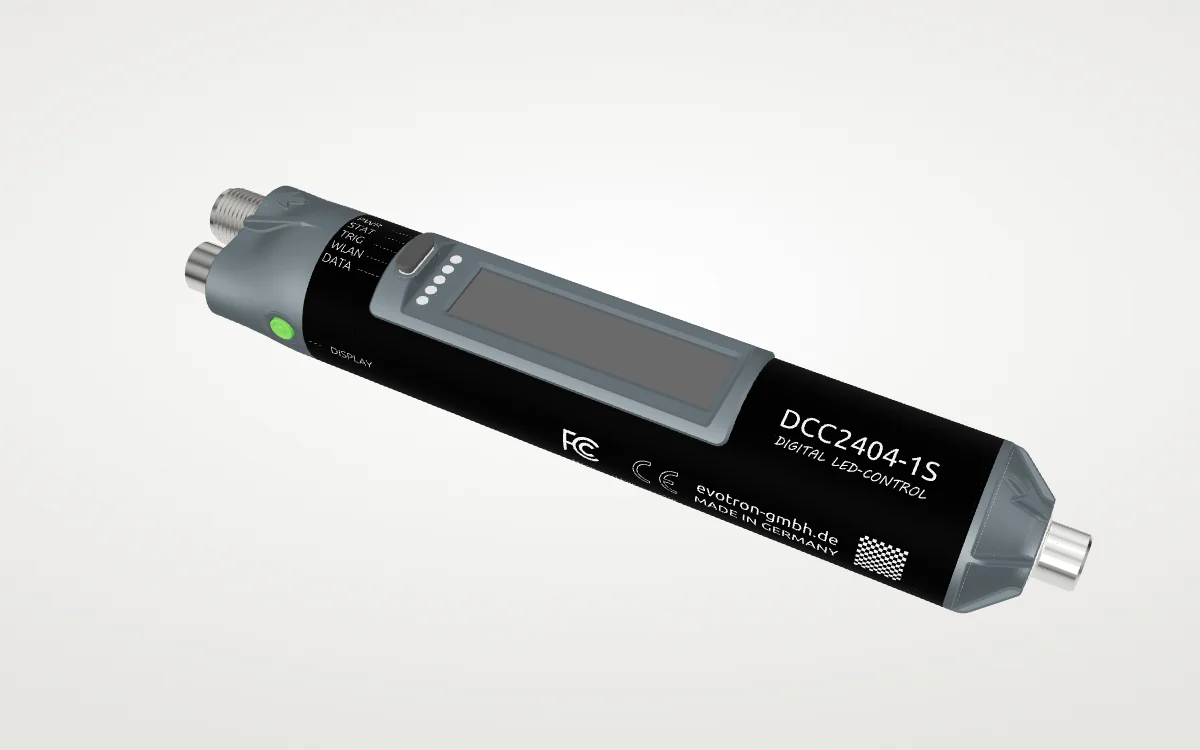
An FPGA regulates the LED current with 14-bit resolution and a quartz-stable time base. It compensates temperature drift and ageing, and shapes high-power pulses along characteristic curves within the electrical, thermal and optical limits of the LEDs. Gallium nitride power stages do this with up to 98 % efficiency, in a controller the size of a cigar.
Operating data, warnings, operating hours and remaining LED lifetime are available on the controller display, in the app, via API and as a status signal to the PLC. Lighting becomes visible to condition monitoring, MES and predictive maintenance. lumiSENS® is currently the only Plug & Play lighting technology on the market built for the industrial IoT.
The result: lighting is no longer a consumable. It is a measured, documented and reproducible part of your vision system.
Performance
Figures of the DCC2404-1WS in-cable controller. Settings directly on the controller, in the app or via API.
Consistent over the entire lifetime of the lighting. Light delay, pulse width and camera trigger are set in 20 ns steps. Camera shutter delay can be compensated.
Pulse after pulse. No energy swings like with capacitor discharge.
In a 20 ns grid, with constant light energy even at 1 µs.
Up to 500,000 precisely timed light pulses per second, for fast moving objects.
Short, fixed and known. Fast trigger output with less than 50 ns.
Up to 8 sectors and 16 sequence steps, fully synchronised to image acquisition, from one single-channel controller.
Interference-free trigger distribution via RS-485 over up to 100 m. Under 2 minutes set-up per camera.
Low-loss GaN power stages waste almost no energy. And because the controller sits in the cable, not in the housing, no extra heat reaches the LEDs: they can be driven harder for more light, and they age more slowly.
Conventional controllers do not notice when LED output falls. lumiSENS® measures it, compensates with current reserve, and tells you early when that reserve runs low. Try it.
Move the sliders and compare both camera images.
Schematic illustration based on typical LED behaviour, not measured data of a specific product.
Lexicon · GermanAgeing and driftHow ageing and drift affect lighting and cameras in machine vision.The right colour decides which feature your camera sees. lumiSENS® switches between the colour channels of multicolour and multispectral lighting while the machine is running, with one single-channel controller and one cable. Pick a colour and watch the monochrome camera image change.
A sensor detects the next part, the PLC sends the matching colour to the controller, and the RGB light switches between two parts. The camera always sees the part in its best contrast.
Schematic illustration. The colour is set via the controller interface; achievable cycle rates depend on the application.
Schematic spectra with typical LED bandwidths. More wavelengths and beam angles on request.
Lexicon · GermanMeasuring lightBackground on measuring light, explained by our academy.Standard wavelengths: 440, 450, 455, 465, 520, 624, 625, 645, 655, 660, 730, 860, 940 and 950 nm, white 4000 to 6700 K, RGB 456 / 515 / 635 nm.
Applications
Proven in demanding inspection and measurement tasks. These are typical ones.
Freeze fast moving parts with short, high-energy flashes that hit the exposure window exactly, every time.
Make surface topography visible independent of colour and texture, for example embossed Braille. One camera, one sector ring light, one single-channel controller.
Change the wavelength while the system is running. Several colour channels from one single-channel controller, switched by API.
RCAM combines camera, lighting and LED controller in one compact robot tool for dynamic image capture during motion.
AI learns from images, and images are made of light. Changing light looks like changing product quality. Constant light keeps it out of AI decisions.
Stable gauge capability, identical machines from series to series, and retrofit of existing systems with standard cables.
High-speed structure measurement of thin-film solar panels in motion. Twelve cameras and their lights fire in exact synchronisation, distributed via RS-485. A demanding exception, and proof of what the platform can do.
Every trigger starts a precisely timed period in the controller: one light pulse and, synchronously, a trigger for the camera. Delays and widths are set in 20 ns steps, so the light lands exactly in the exposure window.
The PLC or an encoder sends the trigger to the controller. The controller fires the light pulse and sends a synchronous TRIGGER-OUT to the camera. Each camera has a shutter delay. Shift the camera trigger and the light pulse until the pulse sits inside the exposure.
Example camera with 1.2 µs shutter delay and 3 µs exposure. Light pulse 2 µs.
The PLC triggers the camera directly. The camera's exposure output triggers the controller, which fires the light pulse with a fixed, known delay of 420 ns. The pulse can be shifted further in 20 ns steps. Ideal when the camera is already integrated into the machine control.
A master controller synchronises further controllers via TRIGGER-OUT, also controllers from other makers. Each controller fires its own light pulse with locally set timing, for example one after another for several lighting directions. For large systems, an RS-485 signal distributor synchronises up to 128 units over up to 100 m, with under 2 minutes set-up per camera.
Four everyday situations in machine building, and what changes with lumiSENS®.
Adjust brightness behind the machine guard, walk to the monitor, check, repeat.
Select the controller via WLAN and set all parameters in the app while watching the camera image.
Every LED lighting runs at its own current and brightness and must be adapted individually.
Copy the parameter set. The controller calibrates a new light of the same type to identical values. Gauge capability stays 1:1, from the first machine to a global roll-out.
Unknown latencies, signal analysis with an oscilloscope on components spread across the machine.
Known delays, trigger shifts in 20 ns steps. Camera triggers light, or light triggers camera.
The lighting fails, or slowly gets darker until the inspection breaks. Unplanned downtime.
Light reserve and remaining operating hours are known in advance. Replacement is planned, not urgent.
Select the controller, connect, and set every lighting parameter while you watch the camera image. Even complex sequences.
lumiSENS® products do more than conventional lighting, but they do not cost more for it. Advanced manufacturing technology compensates the added functionality. The savings come on top, over the whole life of the machine.
Advanced manufacturing technology compensates the added functionality of every lumiSENS® product.
A new light of the same type is calibrated to identical values. Gauge capability is preserved without extra calibration.
Lights are individualised by copying parameter sets. Your spare parts store shrinks.
Example 4-segment ring light: one single-channel controller instead of a multi-channel set-up, and over 75 % less wiring.
Every application is different. Select what applies to yours.
Select the characteristics of your application to see your specific gains.
Hardware and wiring savings for the 4-segment ring light according to the DCC2404-1WS technical manual. Effort for commissioning, service and downtime depends strongly on the application.
The in-cable controllers work with your existing LED lights right away. Combined with lumiSENS® lighting, you get the full platform.
Telecentric lights support all lumiSENS® features. Also available: line, spot, three- and four-side lights, and custom designs.
evotron in-cable controllers also drive LED lighting from other manufacturers. Timing, sequences, app and overload protection work right away. The sensor functions need lumiSENS® lighting.
| Feature | Third-party LED light | lumiSENS® lighting |
|---|---|---|
| Precise flash timing, sequences, app, API | ✓ | ✓ |
| User current limits, overload protection | ✓ | ✓ |
| Auto calibration against drift and ageing | – | ✓ |
| Digital type plate, Plug & Play | – | ✓ |
| Temperature, irradiance, remaining lifetime | – | ✓ |
| Segments and colours from one single-channel controller | – | ✓ |
Lighting decides what a camera can see. Our training and consulting connect machine vision, automation and industrial IoT, from the basics to your specific application.
“Image processing begins with light.”Taught by practitioners in machine vision since 1988, authors of the “Lexikon der industriellen Bildverarbeitung” and co-authors of the “Handbook of Machine Vision”.
lumiSENS® is evotron's patent-pending, fully digital technology platform for machine vision lighting. A light sensor processor in every lumiSENS® lighting measures voltage, current, temperature and light intensity. A digital in-cable LED controller uses this data to keep brightness and flash timing constant over temperature and lifetime, and provides process data for automation and condition monitoring.
The evotron range includes ring lights, area lights including an RGB version, line lights, spot lights, telecentric lights and three- and four-side lights, in standard wavelengths from 440 to 950 nm and white. Other wavelengths, beam angles and custom designs are available on request. The in-cable LED controllers also drive LED lights from other makers.
Yes. The in-cable controllers drive LED lights from other manufacturers within their power class. Timing, sequences, app control and user current limits are available. Auto calibration, the digital type plate and lifetime data require lumiSENS® lighting.
Three industrial I/O channels can be configured as PNP, NPN, push-pull or input, for trigger, status and user signals. Trigger inputs accept TTL to 24 V. For software integration, documented programming interfaces are available to registered customers.
No. Basic settings can be made directly on the controller with its display and button, or fully via API. The DCConfig app for Windows and Linux makes set-up, sequences and monitoring much faster.
The controller detects the new light automatically. With a lumiSENS® light of the same type it calibrates brightness to the stored values, so the machine continues with identical parameters and no new teach-in is needed.
Directly in the lighting cable, in the cable duct, on the wall or on a NS15 or NS35 DIN rail in the control cabinet. Screw connectors on both sides use standard M8 or M12 cables, also drag-chain or robot-suitable types.
Yes. Below the factory limits you can set your own maximum current. This protects people in the working area from glare, and LED lights from other manufacturers from overload.
Yes. Test devices are available on loan. Request one below and tell us about your application.
Request a test device, a sample or a quote. We will get back to you personally.
Prefer to talk? +49 3681 807 64 60 · info@evotron-gmbh.de
Your request is on its way to evotron. We will get back to you personally.
Talk directly to the people who develop lumiSENS®.
Call+49 3681 807 64 60 Emailinfo@evotron-gmbh.de